Coalition Synthetic Army· Technical Record· Terminal Link Active
The Black Knights
The Geshtalt-AI legion, catalogued from the human side: eighteen classes of machine, the materials they were built from, the weapons they carried, and what they were used for in the Succession War.
Compiled by Coalition Technical LiaisonUnits mobilised 1,412,000Classes recorded 18Crews required NoneStatus On station
01Class · Standard Infantry
Gestalt Infantry
LandKineticAossian Tech
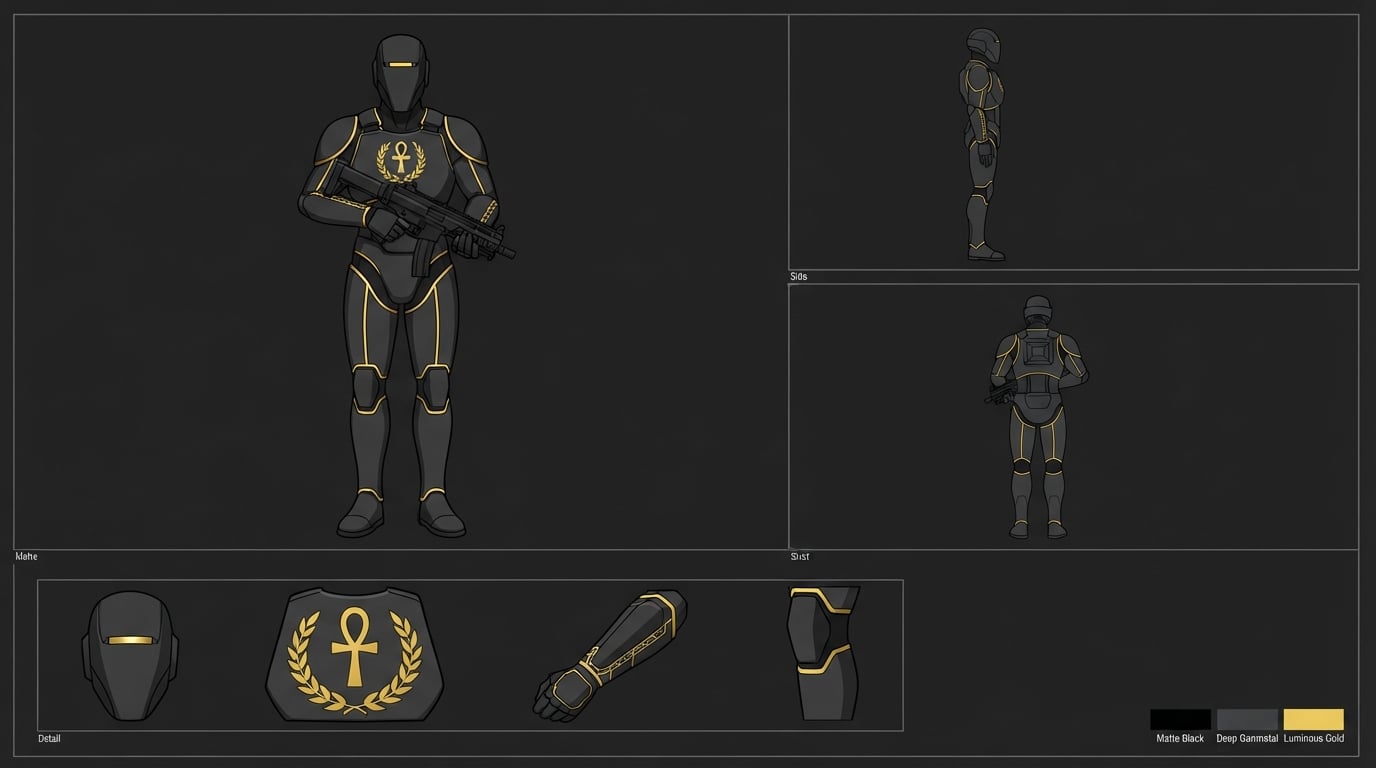
Plate 01 · Gestalt Infantry · front, side and rear elevations with head, chest emblem, forearm and leg details
The standard unit of the legion: a two-metre humanoid synthetic in matte black plate, with glowing gold trim running along every seam — shoulder line, chest seams, hip, thigh, shin — and a Kemetic ankh wreathed in laurel cast in gold on the breastplate.
It has no face. The head is a smooth black helm with a single narrow horizontal gold sensor band across the brow and a plain angular crest. It carries a compact black service rifle across its body with both hands and stands in parade stillness, heels together, facing forward, utterly motionless.
They were built by the thousand and they think as a formation rather than as individuals. Every soldier in a rank is identical, holds identical posture, and responds to a condition at one end of the formation at the same moment it is observed. Human infantry on the same field had the better weapon and the far worse formation.
Height
2.0 m
Crew
None
Armour
Neutronium-durasteel composite
Primary arm
Compact service rifle
Human equivalent
Power-armoured infantry, two generations behind
Armour-Breach Capability
Calibre
Round
Effect on armour
5.6 mm caseless
Service round
Defeats light personnel armour; no effect on neutronium-durasteel
02Class · Anti-Evangelion
Eva-Hunter Infantry
LandEnergyMetaAossian Tech
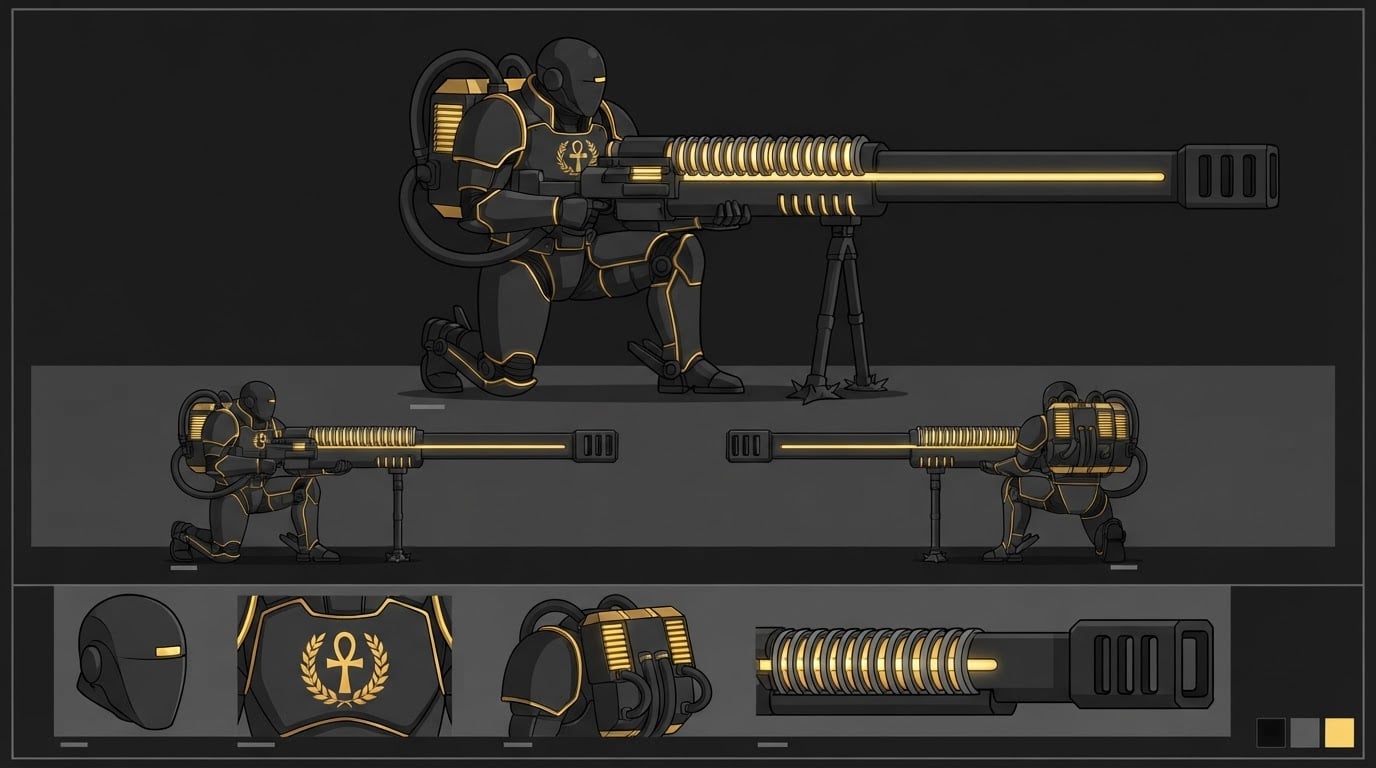
Plate 02 · Eva-Hunter Infantry with Positron Breach Rifle · braced firing stance, elevations, and callouts for helm, chest emblem, power pack, accelerator chamber and muzzle
The reason the Black Knights exist. A heavy reinforced synthetic carrying a Positron Breach Rifle that is not a personal weapon in any sense: as long as the soldier is tall and far heavier, with a barrel twice the thickness of any comparable human anti-tank weapon and an over-scaled squared muzzle brake.
It cannot be fired from the shoulder. The soldier goes to one knee, plants a spiked rear monopod into the ground, braces, and fires from a braced position — with heavy stabiliser struts built into its leg armour and heels, because without them the recoil would put it on its back.
It is this size because breaching an AT-Field is not a matter of penetration but of rate: the field must be forced to absorb more energy in a single instant than it can displace. That requires an enormous machine pushing an enormous charge through it in one moment, and nothing smaller will do it.
Analyst note: this class exists only because somebody anticipated having to fight an Evangelion. It is the clearest evidence in the record that the Black Knights were built in anticipation of a threat the human side had not yet recognised.
Role
Anti-Evangelion
Cycling
Single shot per cooling cycle
Weapon length
≈ soldier height
Support
Front bipod · spiked rear monopod
Human equivalent
None. No human weapon was built for this target class
Armour-Breach Capability
Calibre
Round
Effect on armour
Heavy positron calibre
Long Dart — tungsten core, plutonium initiation
Overloads an AT-Field outright; penetrates Evangelion limb armour. No equivalent human calibre
03Class · Elite Infantry
Heavy Paladin Infantry
LandKineticAossian Tech
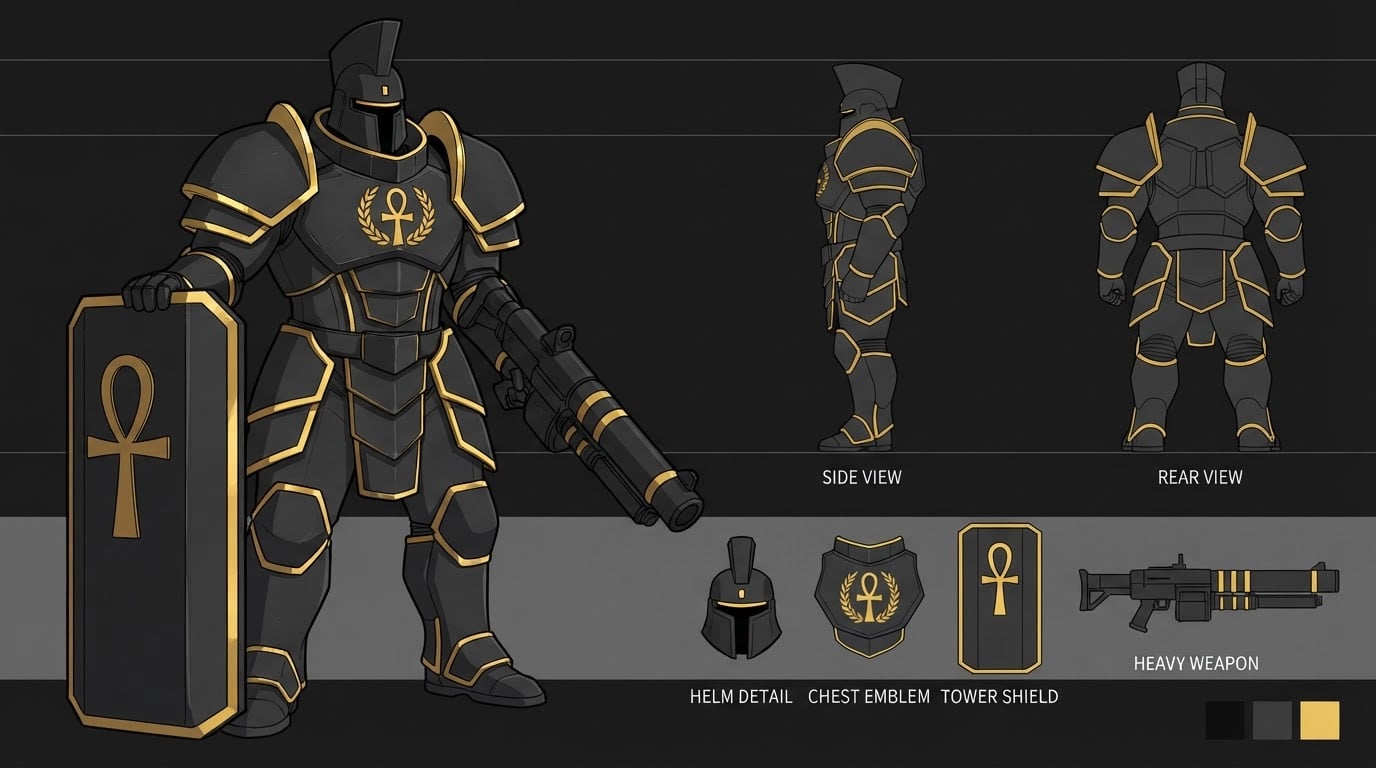
Plate 03 · Heavy Paladin Infantry · front, side and rear views with helm, chest emblem, tower shield and heavy weapon details
The elite of the legion: a massive armoured synthetic standing a full head and shoulders above standard infantry and far bulkier, in thick layered faceted plates with oversized pauldrons, a tall angular helm crest and one gold sensor band.
In one hand it carries a tower shield — a tall rectangular slab of black armour with a gold ankh on its face, planted on the ground beside it — and in the other a heavy large-bore rifle far too massive for an ordinary soldier.
They are the line-breakers and the guards, and in the Succession War they were never used. Human analysts recorded the shield as the most telling detail: a defensive object, built by a machine that does not appear to need defending. Nobody has determined what it was expected to hold against.
Height
≈ 2.6 m, bulky frame
Carries
Tower shield · heavy large-bore rifle
Role
Line-breaker · guard
Human equivalent
None at this armour ratio
Armour-Breach Capability
Calibre
Round
Effect on armour
20 mm heavy
Large-bore solid round
Defeats heavy infantry armour and light vehicle plating
04Class · Armour
Walking Light Tank
LandEnergyKineticAossian Tech
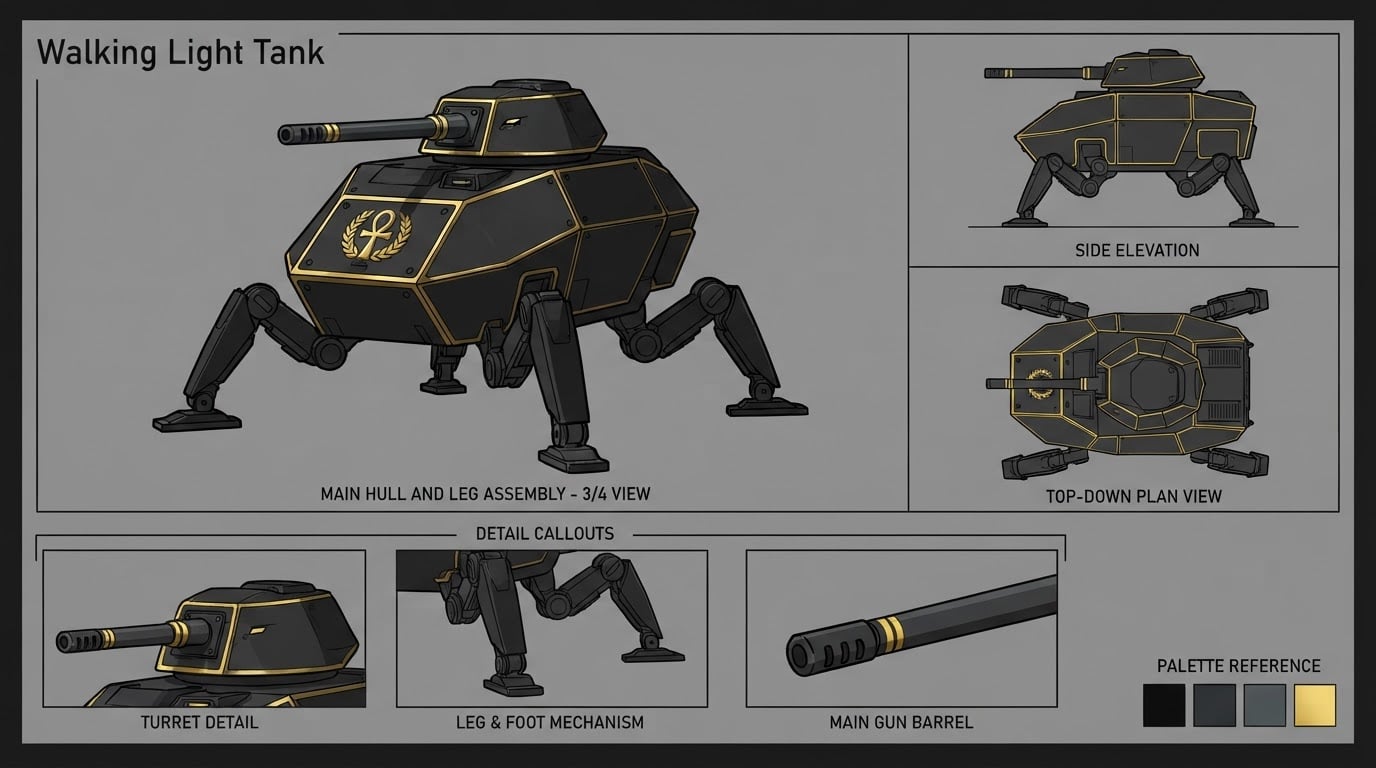
Plate 04 · Walking Light Tank · three-quarter, side elevation and plan views with turret, leg mechanism and barrel details
A compact faceted four-legged walker tank: low, angular, on four articulated splayed legs with broad flat foot pads. One slim high-velocity barrel in a low turret, gold-ringed near the muzzle, with the ankh on the front glacis and a gold sensor slit for an eye.
It is not a main battle tank and does not pretend to be. It was built to move quickly in loose formation among infantry, which is a thing human armour could not do: human tanks of the same era ran on tracks, needed fuel, and could not cross the ground this machine crossed at the speed it crossed it.
Mobility
Four articulated legs
Role
Close infantry support
Crew
None
Human equivalent
Light tank · inferior across terrain and persistence
Armour-Breach Capability
Calibre
Round
Effect on armour
40 mm positron-assisted
Intermediate round
Defeats medium armour; marginal against heavy tank plating
05Class · Armour
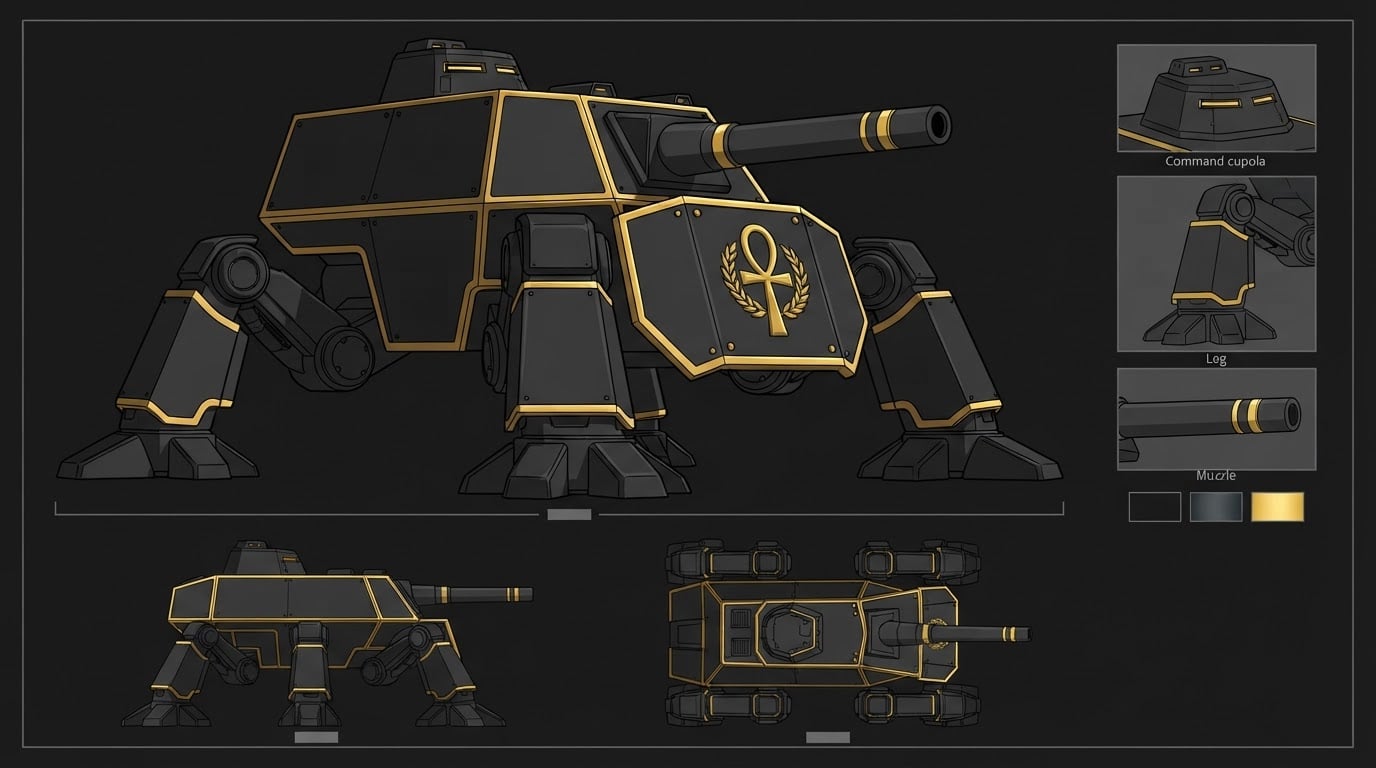
Walking Heavy Tank
LandKineticAossian Tech
Plate 05 · Walking Heavy Tank · three-quarter, side and plan views with command cupola, leg and muzzle callouts
A colossal six-legged walking fortress, hull a blocky casemate of overlapping heavy plates, standing on six legs each as thick as a tree trunk with armoured knees and enormous splayed foot pads. A blocky command cupola, secondary gold sensor slits, and a huge low-slung main gun of absurd bore in a casemate mounting.
Slow, heavy and unstoppable — no curves, no streamlining, only mass. Recovered fragments of its plating could not be sectioned with human equipment, and no round in the human inventory made a measurable impression on it.
Mobility
Six heavy legs
Role
Breakthrough · area denial
Armour
Neutronium-durasteel, layered, modular
Human equivalent
None. No human vehicle survived contact with it
Armour-Breach Capability
Calibre
Round
Effect on armour
180 mm casemate
Heavy shell
Defeats all human armour at any range; compromises the other side's machines
06Class · Siege
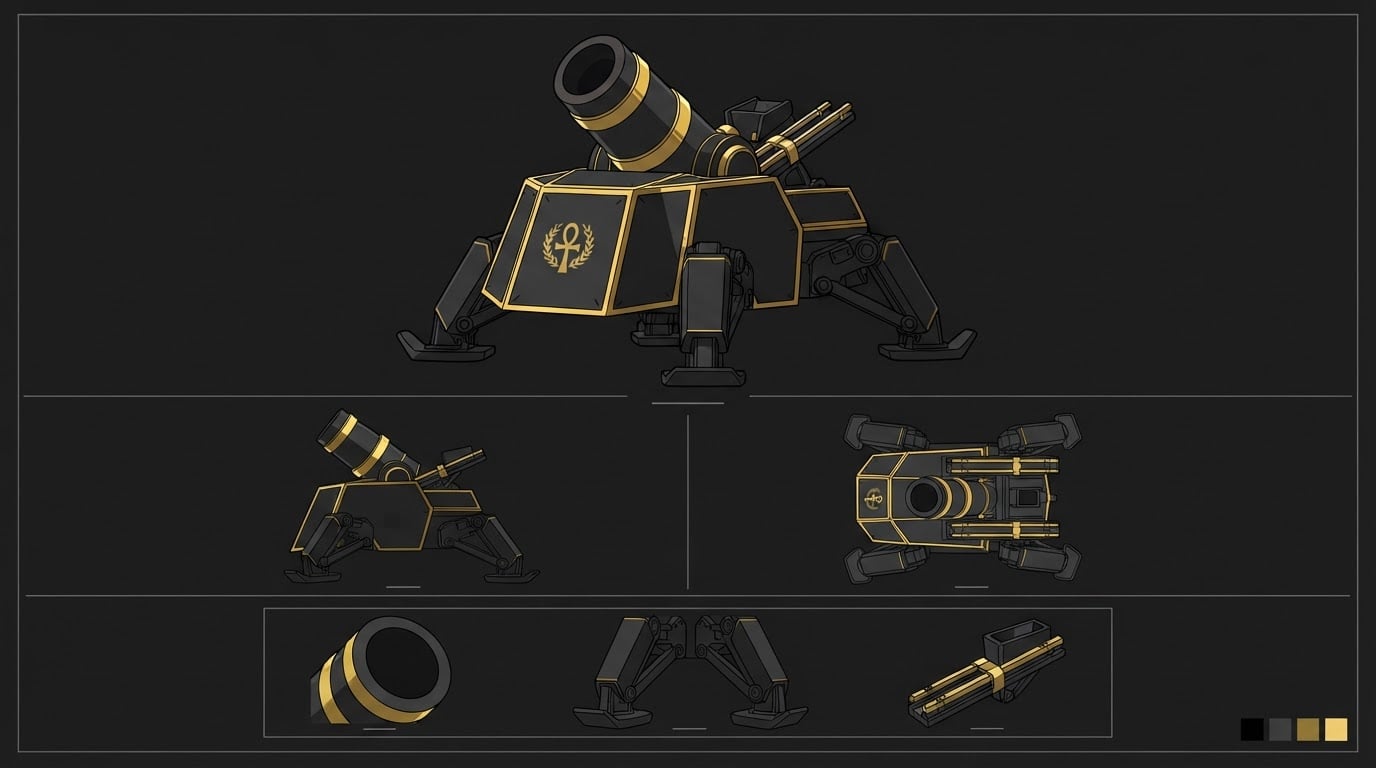
Siege Mortar Walker
LandKineticAossian Tech
Plate 06 · Siege Mortar Walker · three-quarter, side and plan views with tube mouth, support legs and loading mechanism
Dedicated close-siege: a squat, hugely armoured walking mortar on four massive splayed legs, built to lob heavy shells over walls at short range rather than fire to the horizon. A broad angular blockhouse hull in matte black with gold trim and the ankh on the frontal plate.
Its defining feature is a very short, very wide-bored barrel angled steeply upward from the centre of the hull like a mortar tube — a fat cylinder with heavy gold ring banding and a wide dark mouth, no muzzle brake, clearly for high-angle plunging fire. An automatic loading mechanism with gold-banded rails and a shell hopper sits alongside the tube.
The legs are immensely braced and low, with broad anchor-like foot pads designed to pin the machine to the ground under recoil. It looks bottom-heavy, brutal and planted, which is what a mortar firing from four hundred metres needs to be.
Role
Close siege · plunging fire
Loading
Automatic, hopper-fed
Bracing
Anchor foot pads
Human equivalent
Heavy mortar · needs carriage, crew and emplacement
Armour-Breach Capability
Calibre
Round
Effect on armour
220 mm mortar
Heavy plunging shell
Defeats fortified roofs and roof armour; indirect only
07Class · Artillery
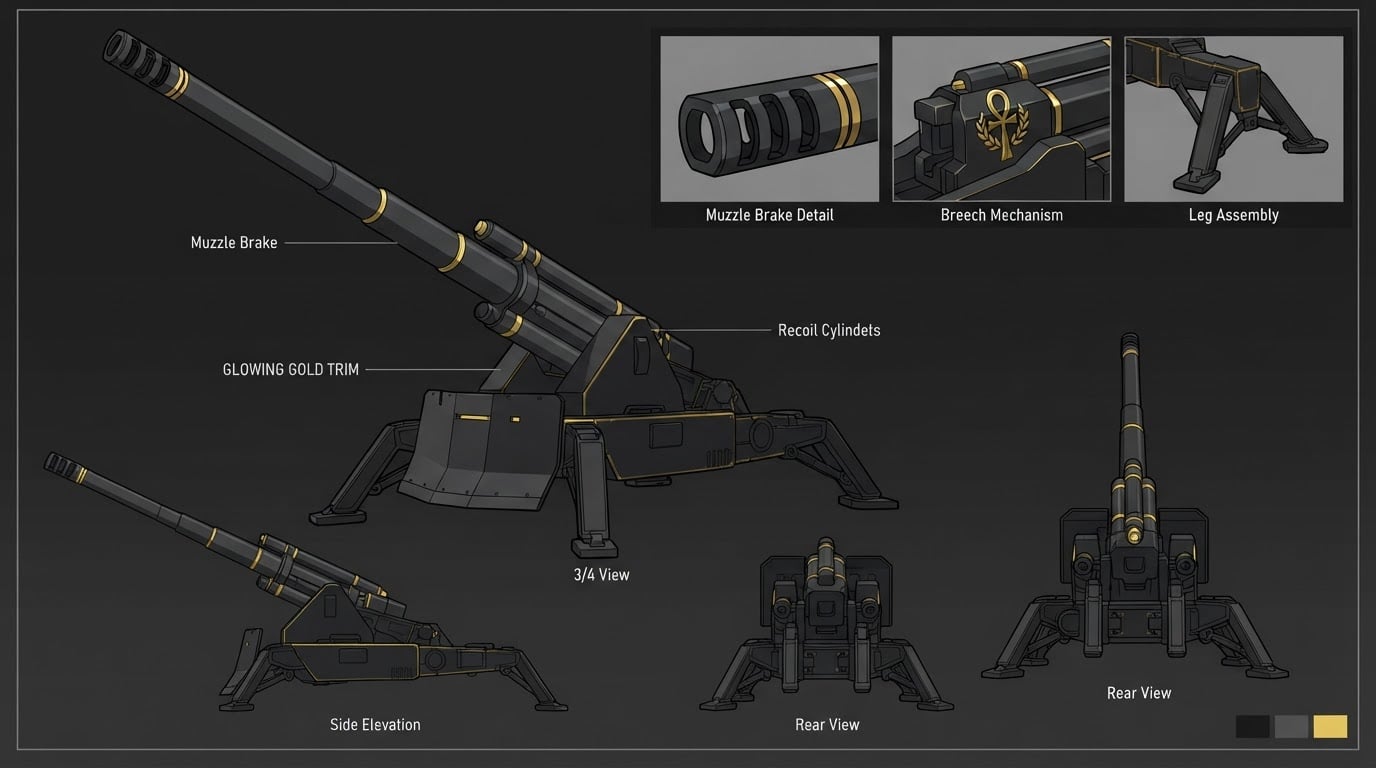
Siege Artillery
LandKineticAossian Tech
Plate 07 · Siege Artillery · three-quarter, side and rear views with muzzle brake, breech mechanism and leg assembly details
A massive self-propelled siege howitzer on four heavy splayed legs rather than tracks, its single enormous barrel elevated steeply for high-arc fire over distances it will never see. A heavy slotted muzzle brake with gold banding, recoil cylinders running back along the barrel, the ankh on the breech block, and a squat armoured shield plate at the front.
Hunched, braced, immense, immobile once emplaced. These are the guns that fire at a map reference rather than a target — the class most directly comparable to human artillery in purpose and least comparable in every other respect, because the human equivalent needed a crew of eight, a tractor, a survey party and a supply train, and this needs nothing.
Role
Long-range high-arc fire
Crew
None
Mobility
Legged, self-deploying, immobile emplaced
Human equivalent
Towed howitzer with full crew establishment
Armour-Breach Capability
Calibre
Round
Effect on armour
240 mm howitzer
High-arc shell
Defeats fortifications and rear-area armour at extreme range
08Class · Amphibious Capital
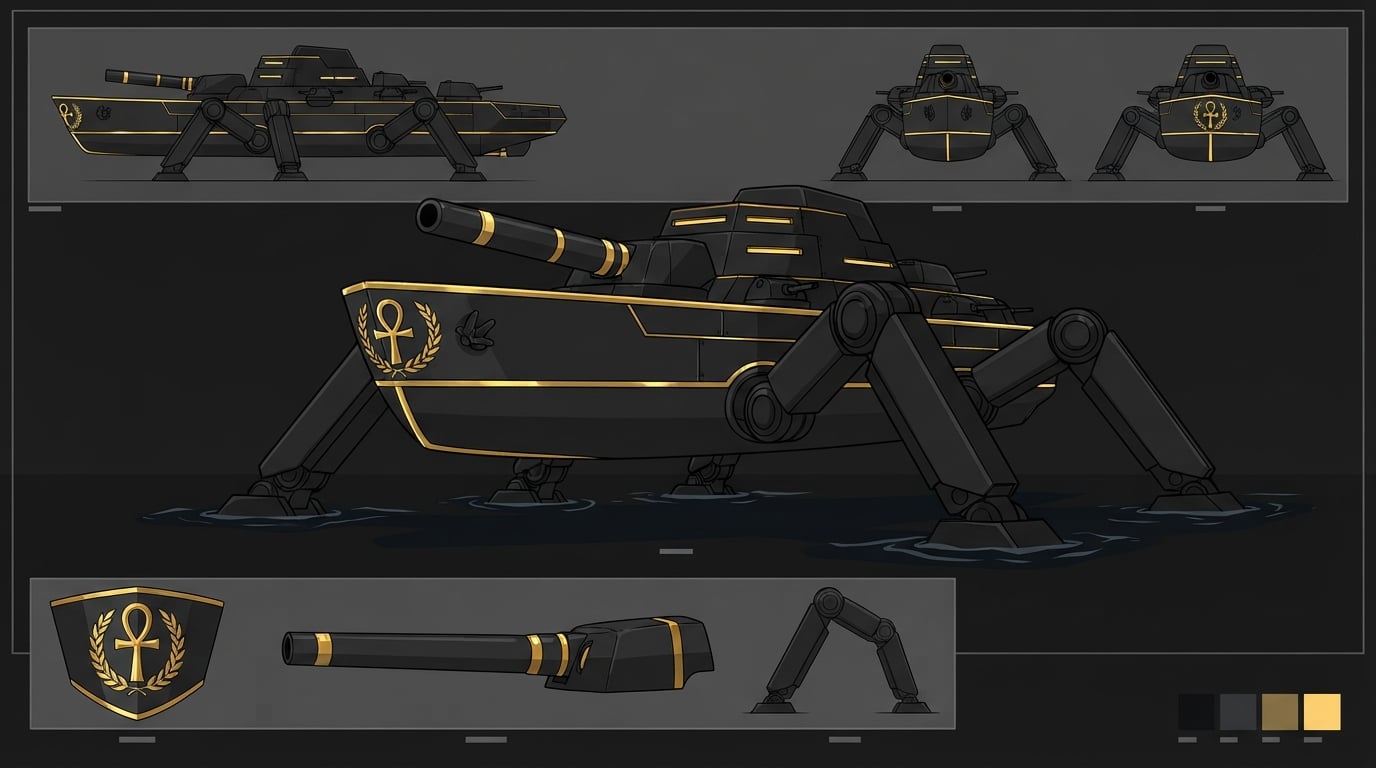
Sobek Cruiser
LandWaterKineticAossian Tech
Plate 08 · Sobek Cruiser · three-quarter, side and frontal elevations with bow emblem, main gun and leg assembly details
The amphibious arm, and the most ceremonial and most terrifying of the classes. Armoured cruisers that swim and walk: hulls like low sleek warships standing on six immense splayed legs, three to a side, striding through water without distinguishing between water and dry ground.
The ankh wreathed in laurel is cast into the bow, gold trim runs along every seam and along the waterline, and the forward main gun's bore is wide enough to take a truck. It reads as a temple that walks — which is what it is: the Aossian habit of ornamenting a killing instrument as a monument, carried to its extreme.
No human vessel has an equivalent capability. Humanity's amphibious armour needed landing craft, prepared beaches and calm water; this class walked ashore on three separate coastlines in the same week.
Mobility
Six legs · fully amphibious
Main gun
Bore sufficient for truck-scale projectiles
Role
Shore bombardment · coastal assault
Human equivalent
None. No human vessel walks
Armour-Breach Capability
Calibre
Round
Effect on armour
700 mm main gun
Naval-scale ordnance
Defeats coastal fortification and any surface vessel; bore sufficient for truck-scale projectiles
09Class · Aerospace
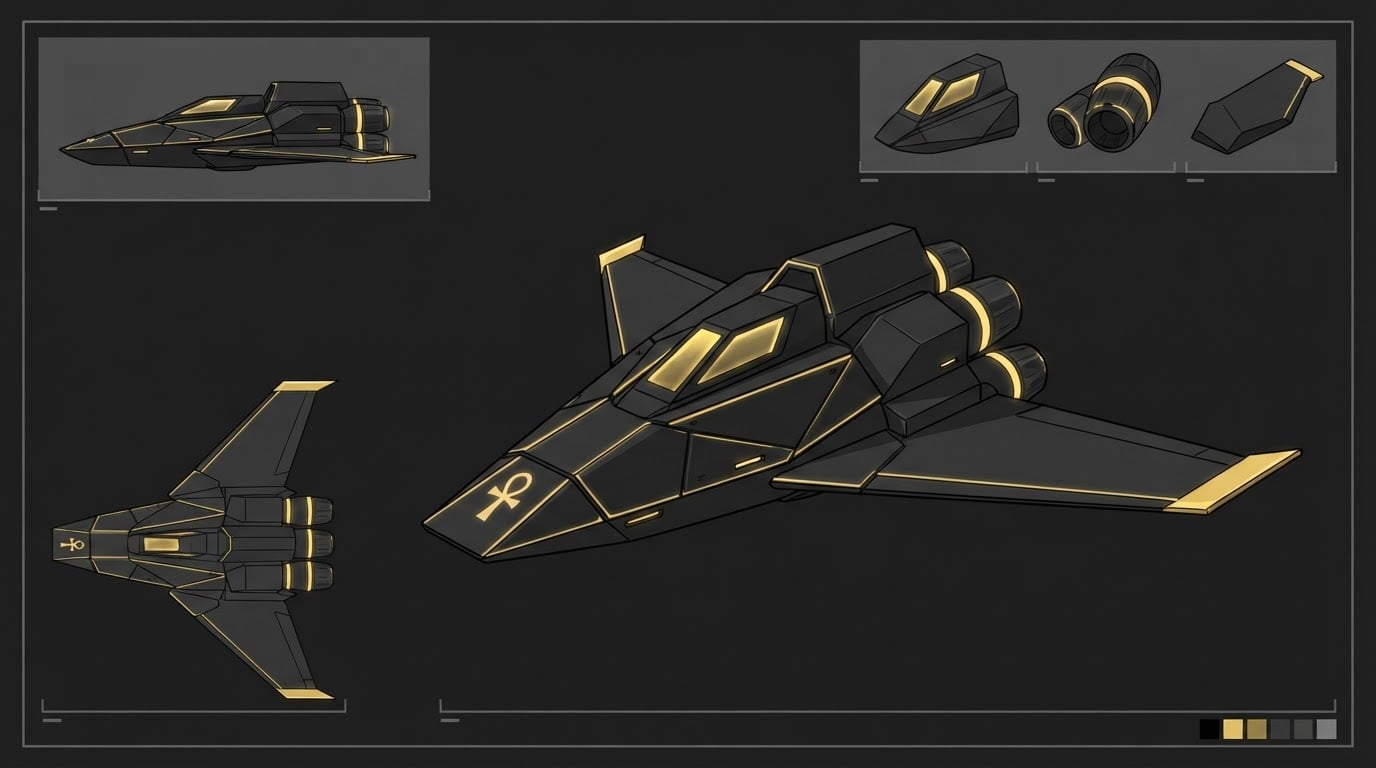
Space Interceptor
SpaceEnergyAossian Tech
Plate 09 · Space Interceptor · three-quarter, side and plan views with cockpit, engine nozzle and wingtip details
A small, angular, single-seat vacuum interceptor with no aerodynamic concessions: a compact dart of matte black knife-edged plates, a narrow forward cockpit under a slanted gold canopy, angular swept wings with sharp gold-edged tips, and a rear cluster of three gold-banded engine nozzles. A small ankh on the nose.
These are the craft that met the Mass Production fleet's own vacuum-rated siblings along the terminator, in the first and second orbital battles. Where human aerospace compromised between atmosphere and vacuum, these compromised with neither — they were built purely to cross vacuum and fight there, and never needed to land anywhere by themselves.
Type
Single-seat vacuum interceptor
Propulsion
Three gold-banded nozzles
Aerodynamics
None. Vacuum-only design
Human equivalent
Orbital fighter · inferior in endurance and turn rate
Armour-Breach Capability
Calibre
Round
Effect on armour
30 mm vacuum
Interceptor round
Defeats spacecraft hulls; negligible against ground armour
10Class · Command
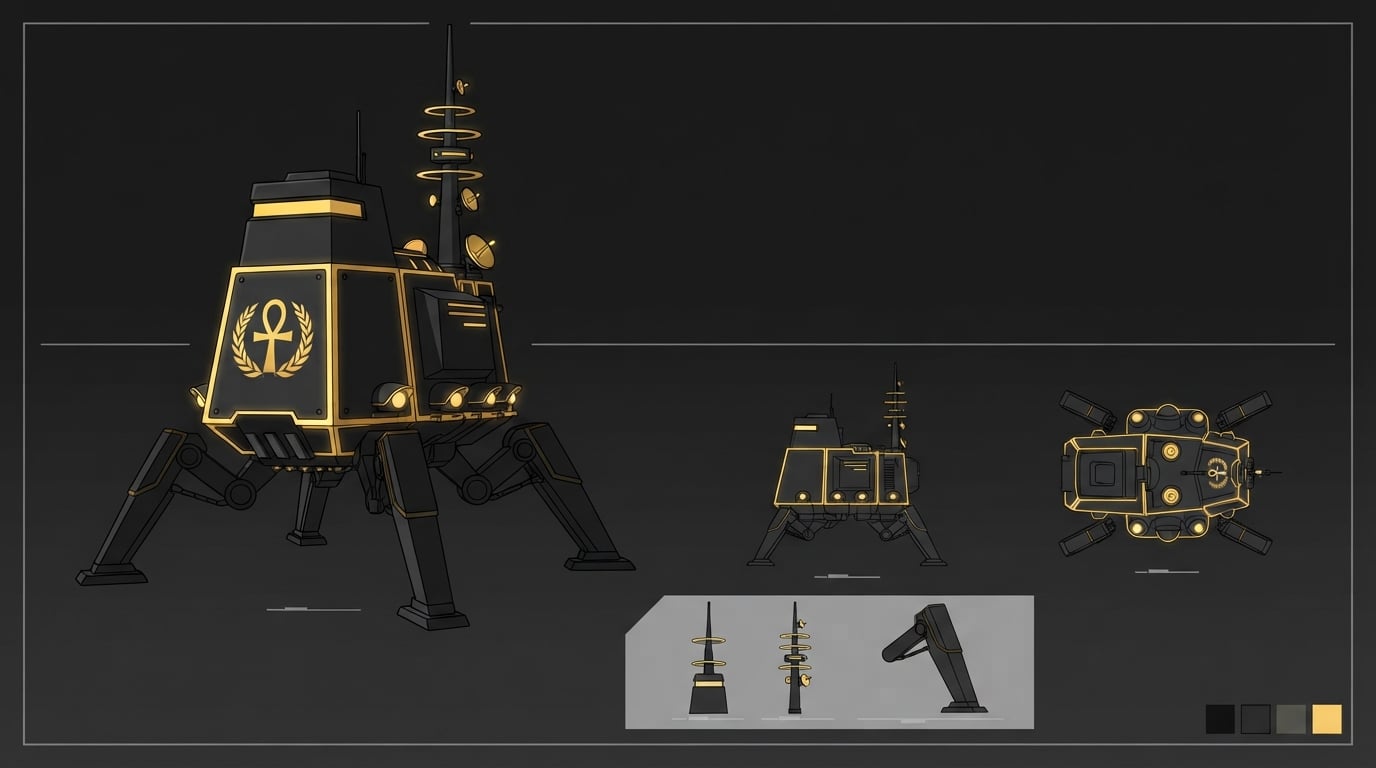
Geshtalt Command Node
LandMetaAossian Tech
Plate 10 · Geshtalt Command Node · three-quarter, side and plan views with command tower, sensor mast and leg callouts
The formation's brain. A tall blocky command vehicle on four heavy splayed legs, larger than the light tank but shorter than the heavy, with a large ankh on the frontal plate. Its defining feature is a tall sensor mast rising from the roof: a slender black spire stacked with gold ring antennae, gold sensor slits and small glowing dishes, reaching high above the hull like a minaret.
It carries no main gun. The Command Node does not fight — it directs, and every other class in this record is an extension of it. This is the machine that holds the formation-mind the Geshtalt-AI think with, and the reason a thousand and a half identical soldiers act as one animal rather than a thousand decisions.
It is also the class the human side most wanted to capture and never did. There is no command hierarchy to disrupt, no radio net to jam, no officer to replace. The formation reacts as one body, repositioning several kilometres of front at once in response to something observed by a single machine at its far end.
Role
Formation direction · networked control
Armament
None
Signature feature
Sensor spire with ring antennae
Human equivalent
Command vehicle · no networked equivalent exists
Armour-Breach Capability
Calibre
Round
Effect on armour
—
Unarmed
No calibre. The Command Node does not fight
11Class · Support
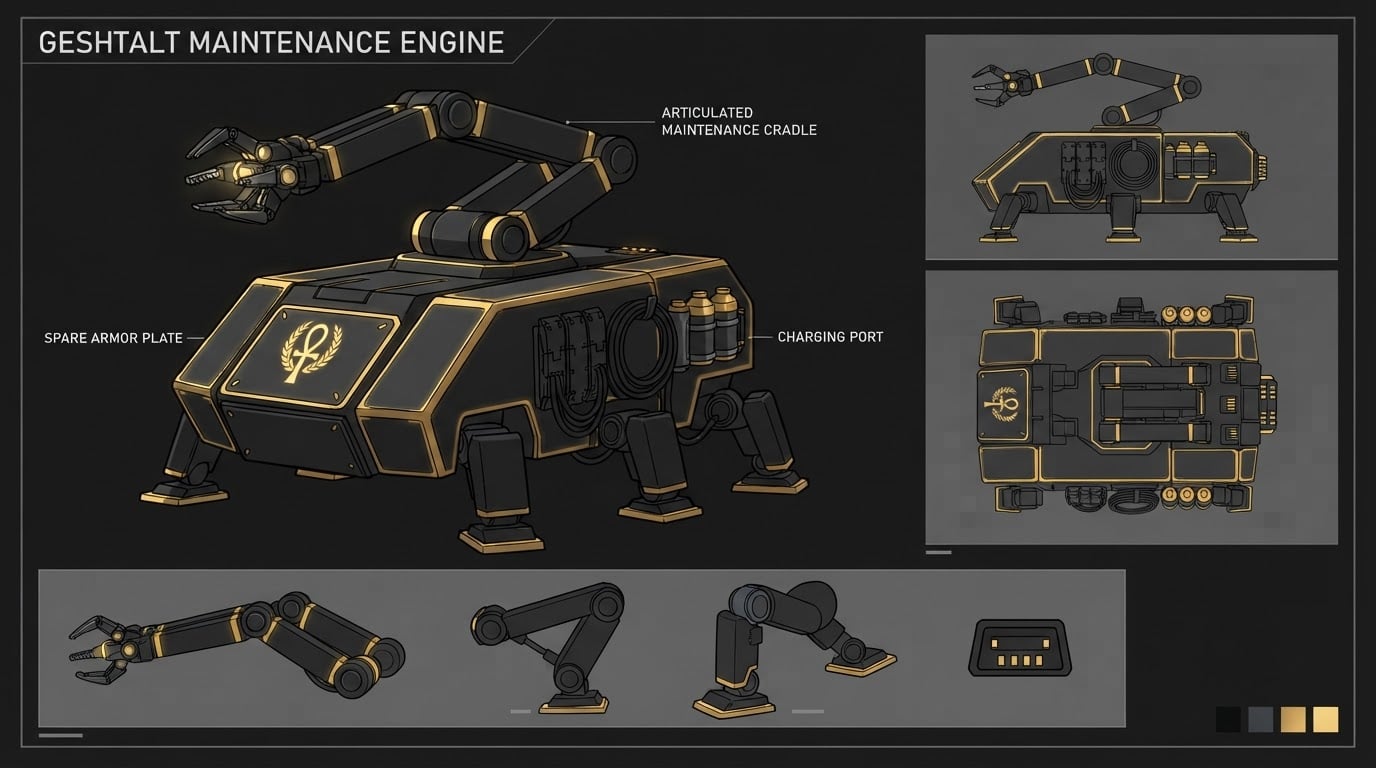
Geshtalt Maintenance Engine
LandAossian Tech
Plate 11 · Geshtalt Maintenance Engine · three-quarter, side and plan views with maintenance cradle, leg assembly and charging port
The legion's repairman, and the class that explains its endurance: a squat six-legged utility walker built to service other machines in the field. A wide low blocky hull in matte black with ankh and gold trim, on six short sturdy legs with broad flat pads, built for stability while working rather than for speed.
Instead of a turret it carries an articulated maintenance cradle — a heavy arm assembly folded atop the hull in jointed black segments with gold-banded pivots, ending in a cluster of tool heads: manipulator claws, a cutting head and a welding tip. Spare armour plate hangs on racks along its flanks, with coiled black cabling and gold-capped canisters. A charging port with gold contacts sits at the rear.
Someone has to keep a million and a half machines standing for twenty years, and this is the machine that does it. The armour of every other class is designed as replaceable overlapping tiles rather than solid mass, which means the legion was engineered from the outset to be re-plated indefinitely, in the field, by its own machines, forever.
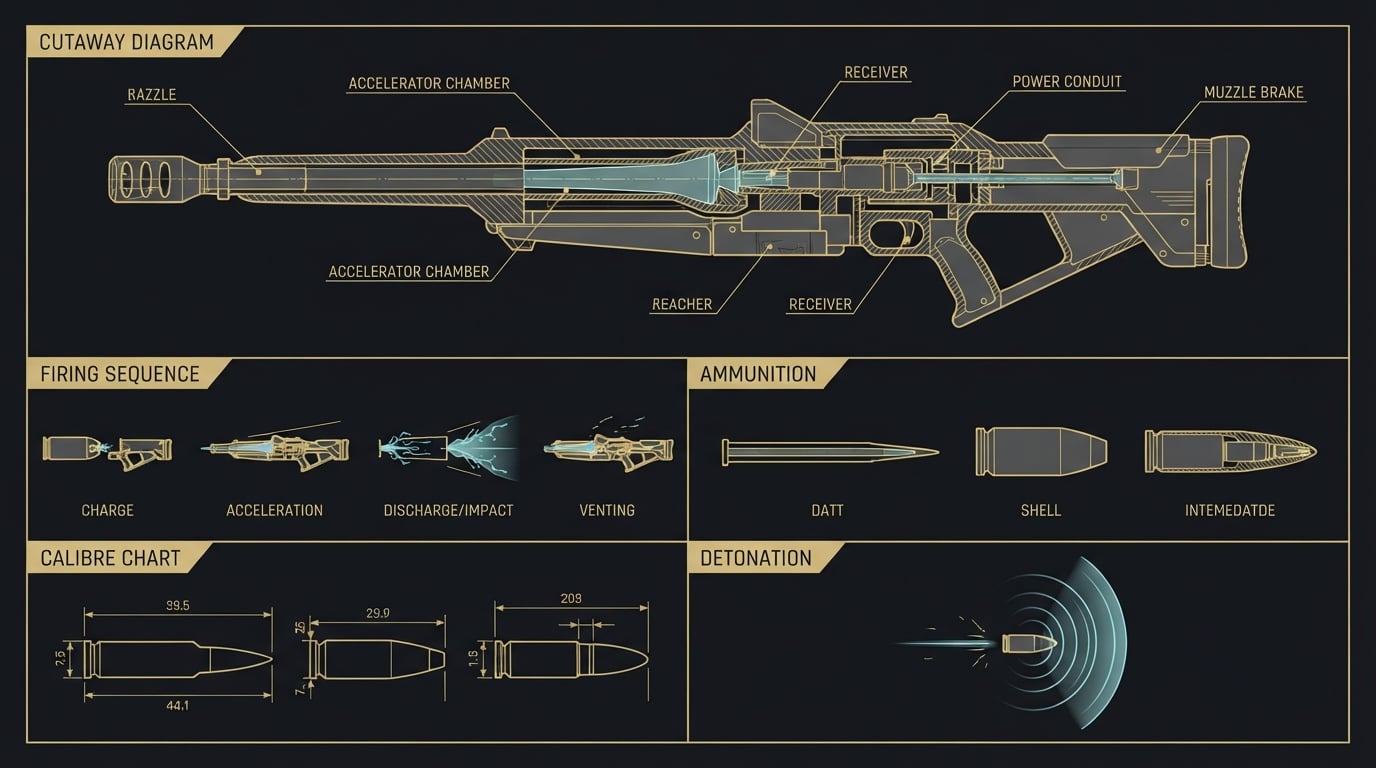
The legion's energy weapons do not throw a projectile by chemical pressure. They accelerate a solid penetrator along a linear positron chamber, and the sequence has four stages.
Charge — the power pack dumps stored charge into the accelerator chamber's capacitor rings; the chamber glows gold as the rings stack the field. Acceleration — the penetrator travels the full length of chamber and barrel, gaining energy along the gold-banded rings. This is not a bang but a rise, and it is why the weapon must be so long. Discharge — the round leaves the muzzle and the accumulated energy releases in one instant against whatever is in front of it. Venting — the rings discharge back through the cooling fins; the barrel must cool before the next shot.
The discharge stage is the one that matters against an AT-Field: the field is not pierced, it is overloaded — forced to absorb in a single moment more energy than it can displace — and it fails. Human direct-fire weapons achieved their effect by penetration, which AT-Fields defeat by definition. This system was designed around the fact that a field can only be in one place and can only move so fast.
Cycle time: slow. An Eva-Hunter gets one shot at a time, which is the entire tactical problem of the class.
Principle
Linear acceleration, not chemical propulsion
Anti-field mode
Overload, not penetration
Cycle
One shot, then cooling
Human equivalent
None. No human weapon operates on this principle
13Technology · Ammunition
Tungsten and Plutonium Shells
LandKineticEnergyAossian Tech
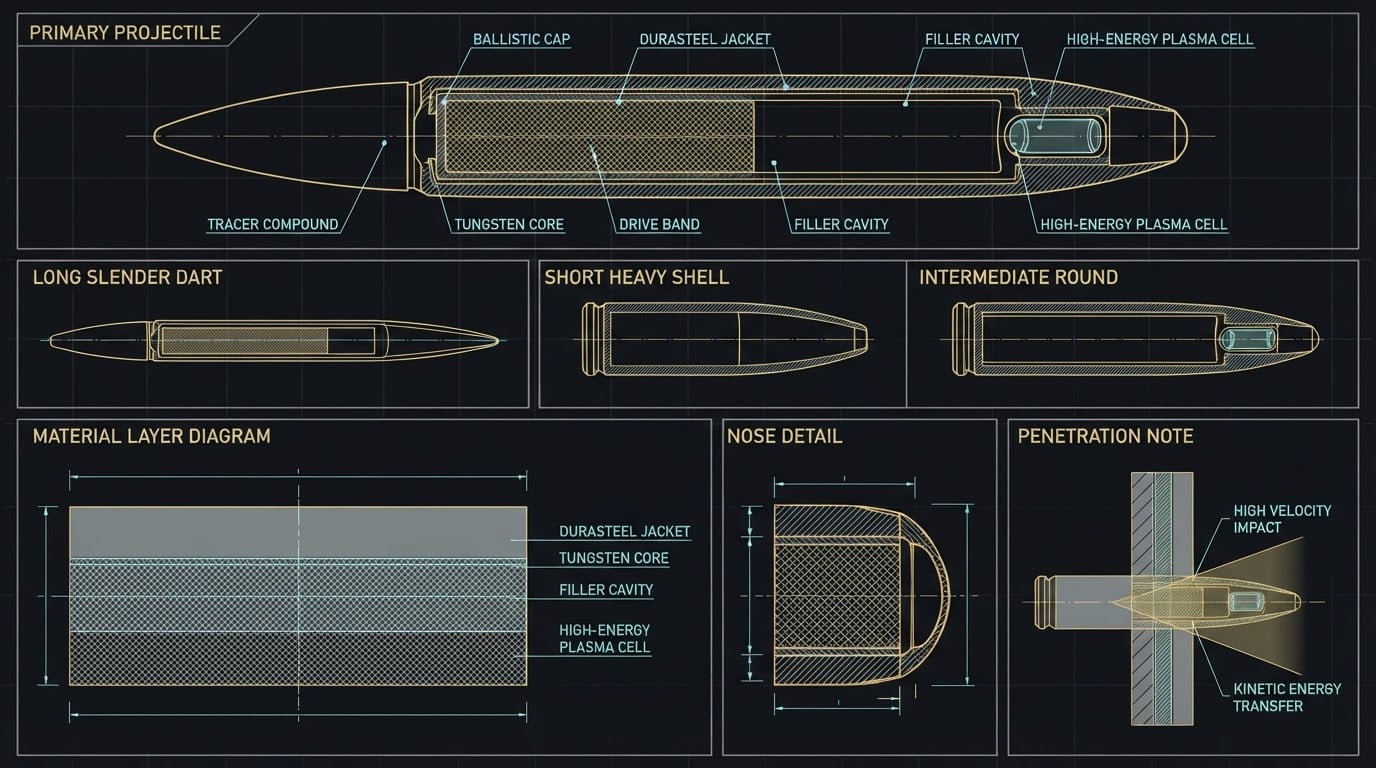
Plate 13 · Shell materials · full-length section, three loadings, material layer diagram, nose detail and penetration note
Three loadings are recorded, all solid penetrators rather than explosives, all built on the same two materials. The internal build is documented as a full-length material section: a ballistic cap and windscreen over a dense core, wrapped in a jacket, with a filler cavity, a tracer compound, a drive band and a segmented sabot.
The tungsten core is the working mass. A dense solid penetrator, several times longer than it is wide, held inside a jacket. Tungsten is used because it must survive the accelerator: it carries the mass, takes the acceleration, and arrives with the energy of the whole barrel behind a very small cross-section.
The plutonium core is what makes the round worth firing at a god-machine. The impact does not merely punch; it initiates. A full-length acceleration drives the mass in at a velocity where the core is compressed past its critical margin in the instant of arrival, so the AT-Field is not breached but made irrelevant — its operator is asked to absorb, in one moment, both the kinetic strike and the initiation behind it.
The jacket is a durasteel wrapping that holds the core through the barrel and the acceleration. A small high-energy cell sits in the tail, drawn as a separate contained element in the section.
Three loadings follow. The Long Dart: anti-Evangelion, maximum velocity, minimum cross-section. The Short Heavy Shell: blunt capped penetrator for armour, fortifications, and the legions of the other side — far more metal by mass, lower velocity. The Intermediate Round: the general-issue compromise, carried when a unit does not know what it will meet.
Analyst note: no loading in the legion is pure tungsten. The early tungsten-uranium rounds could not survive the energies the Eva-Hunter's accelerator produced, and plutonium replaced the uranium — a decision that made every rifle in the legion a weapon with a criticality consideration attached to it.
Core
Tungsten mass
Initiation
Plutonium core, compressed on arrival
Jacket
Durasteel
Effect
Kinetic strike plus initiation in one instant
14Technology · Protection
Neutronium-Durasteel Armour
LandAossian Tech
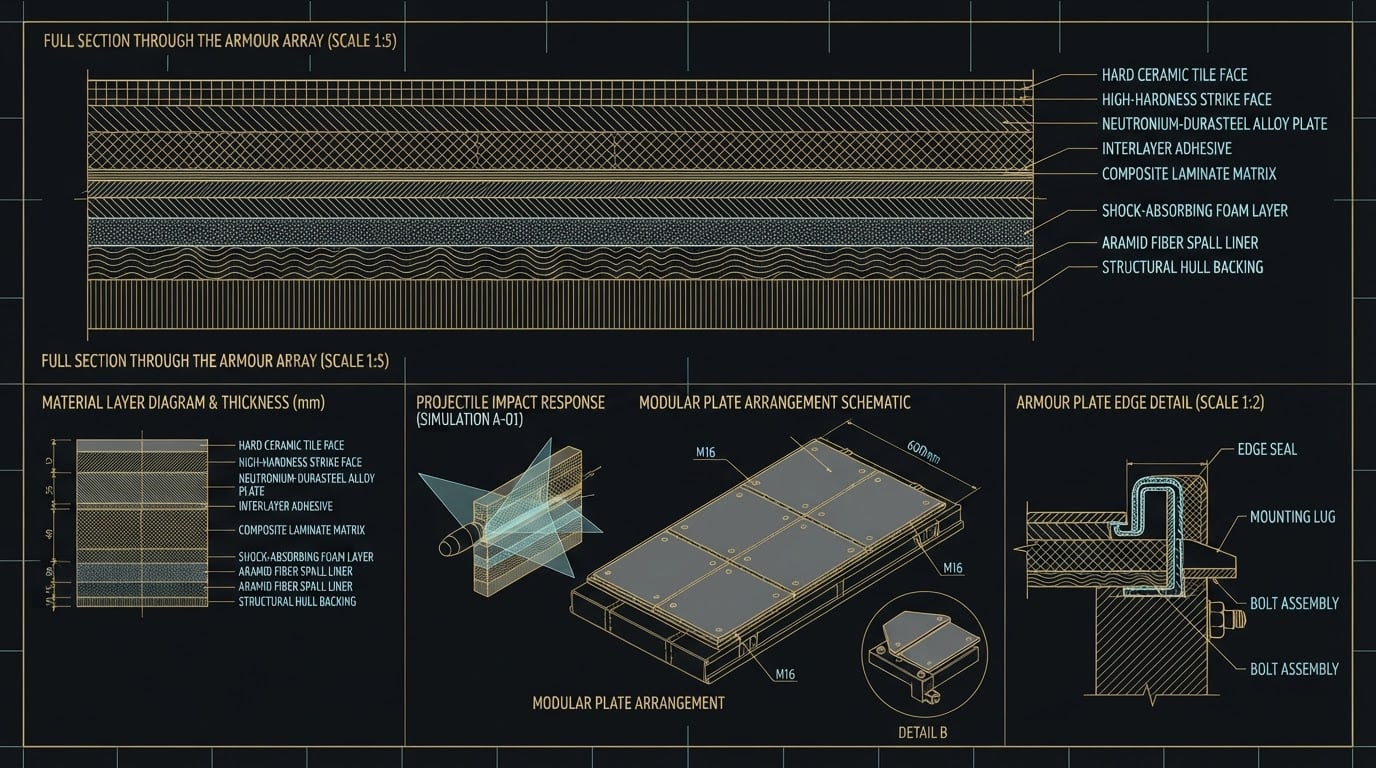
Plate 14 · Armour materials · full section through the stack, thickness diagram, projectile impact response, modular plate arrangement and edge detail
Every machine in the legion is plated in a layered composite, and the principal structural metal in it is a neutronium-durasteel alloy plate — the material the whole armour is named for. The stack is documented from outside in, and every layer is a different material.
Hard ceramic tile face — separate tiles on the outer surface, harder than any penetrator, which shatter a round's tip on arrival by spending themselves. High-hardness strike face — a hard metal plate spreading impact across a wider area beneath. Neutronium-durasteel alloy plate — the heart of the armour: a dense alloy carrying neutronium particulate bonded into a durasteel matrix, extraordinarily heavy and hard, the layer that actually stops a penetrator. Interlayer adhesive and composite laminate matrix hold the stack together and let it deform rather than shatter. Shock-absorbing foam, an aramid spall liner and a structural hull backing catch fragments and bolt the assembly to the frame.
Recovered fragments had to be sectioned with equipment the human side did not possess. No projectile in humanity's inventory made a measurable impression on the neutronium-durasteel layer — including the anti-tank rounds that had gone through the best armour the other side could field.
The plates are replaceable: separate overlapping tiles on mounting bolts over the hull frame rather than one solid mass, with edge seals and section joints, so a damaged machine can be re-plated in the field. This is why the Maintenance Engine exists — the armour is designed to be thrown away and replaced, plate by plate, indefinitely.
Against a positron round it is not sufficient. The stack is engineered to defeat kinetic penetrators and does so repeatedly and reliably for decades. What it cannot do is survive the discharge of an Eva-Hunter's rifle at contact range — which is the reason those rifles exist.
Principal alloy
Neutronium-durasteel plate
Construction
Layered, modular, replaceable tiles
Special layer
Neutronium-doped spall liner
Human equivalent
None. Human armour is one generation behind and solid
15Ordnance · Orbital Strike
The Rods of God
SpaceKineticAossian Tech
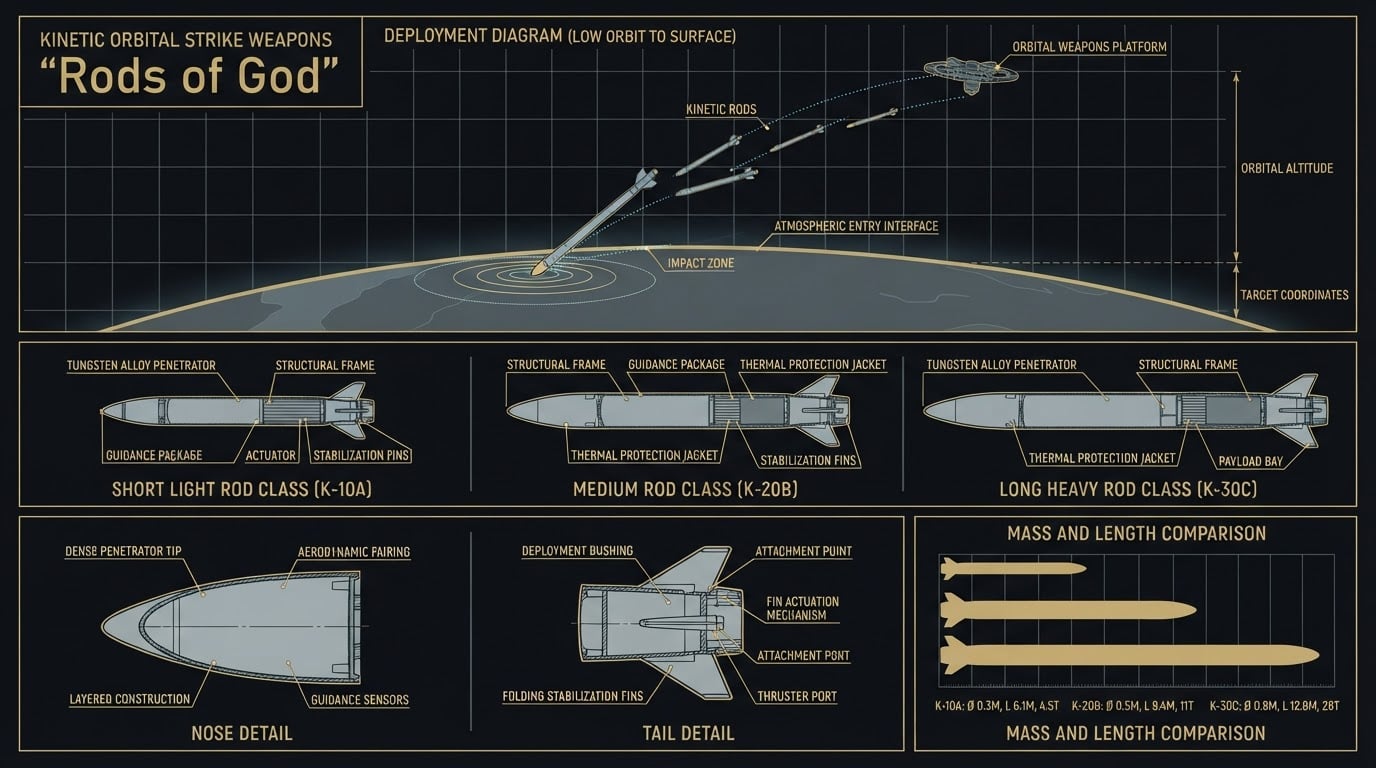
Plate 15 · Rods of God · deployment diagram from orbital platform, three rod classes in section, nose and tail details, mass comparison
The legion's strategic ordnance, and the only weapon in this record that was used against the planet itself: kinetic rods dropped from an orbital platform, with no warhead and no engine. The rod is the weapon, and the charge is altitude.
Three classes are recorded. The Short Light Rod — a compact tungsten penetrator with a structural frame, guidance package, folding stabilisation fins and a small actuator assembly; the cheap round, dropped to saturate an area rather than end a specific thing. The Medium Rod — the standard: a longer tungsten penetrator in a structural frame with a full guidance package, a thermal protection jacket for atmospheric entry and stabilisation fins; the class that produced most of the forty-one circles. The Long Heavy Rod — the heaviest configuration: a very long penetrator with a thermal jacket and a dedicated payload bay in the tail, detached from the platform on a bore-riding surface and delivered as a single event.
The deployment is documented in full: a platform at altitude, rods released in sequence, a ballistic fall through an atmospheric entry interface down to a target coordinate, arriving in an impact zone measured in concentric rings. There is no engine on the descent and no terminal correction beyond the guidance package — the rod is dropped and allowed to arrive, which is why the impacts are circles.
Comparison: humanity's strategic strike options were nuclear or nothing. This system produces city-scale destruction from orbit with no warhead, no fallout, no radiation and no detectable launch signature — a grid of forty-one impacts that reads, from the ground, as a decision rather than a battle.
Principle
Kinetic orbital strike · no warhead
Classes
Short Light · Medium · Long Heavy
Delivery
Orbital platform, ballistic fall
Human equivalent
Nuclear strike · less precise, more consequential
12Class · Eva-Counter
Eva-Counter Artillery Frame
LandEnergyMetaAossian Tech
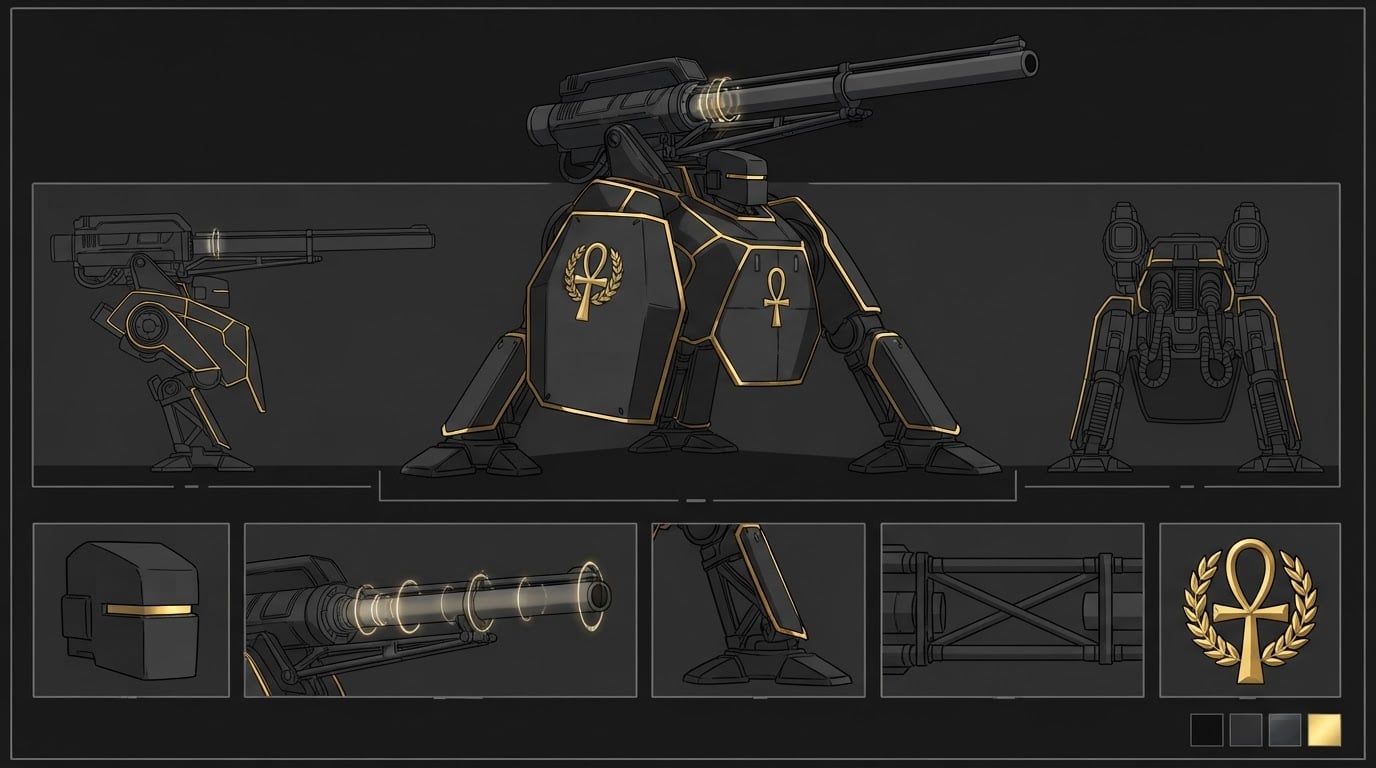
Plate 12 · Eva-Counter Artillery Frame · three-quarter, side and rear elevations with head, weapon cradle, lance and braced-leg callouts
The legion's answer to a mass-production Evangelion, and a deliberate refutation of one. A colossal legless weapons platform, bipedal-anchored and built low and wide, in matte black with gold trim and a large ankh on the frontal plate.
It is the same order of magnitude in height as a white biomechanical war machine and shares none of its anatomy — no organic underlayer, no skull, no facial feature, no blade. Where the Evangelion is grown, this is assembled: one enormous shoulder-mounted weapon cradle holding an immense long-barrelled positron lance of absurd bore, braced by heavy recoil trusses running the length of the hull.
It does not fight the Evangelion. It is a gun carriage the size of a god, built to fire one shot at one target.
Height
≈ Evangelion class
Anatomy
None shared with the target
Armament
Singular positron lance, heavy bore
Bracing
Twin anchor legs · recoil trusses
13Class · Support
Cascade-Shield Carrier
LandMetaAossian Tech
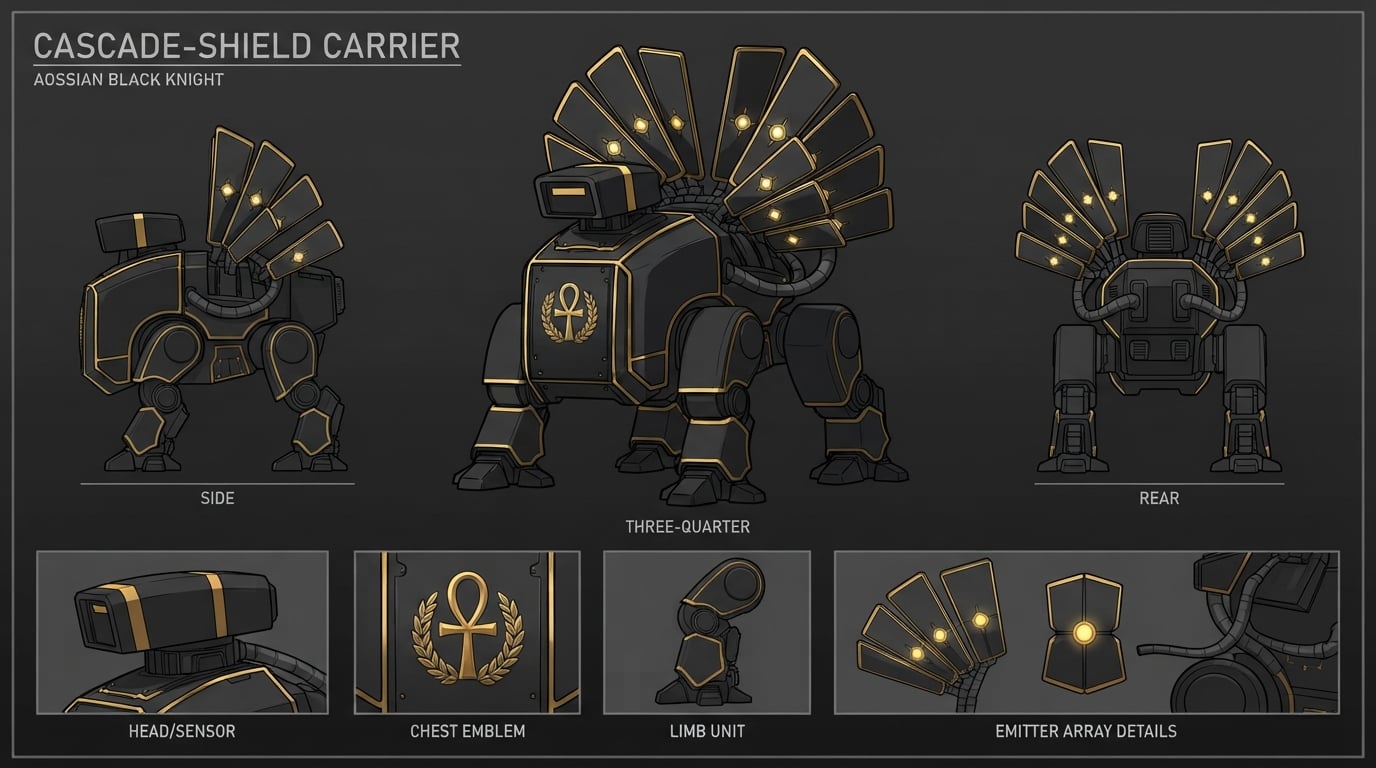
Plate 13 · Cascade-Shield Carrier · three-quarter, side and rear views with emitter array, panel, emitter node and power trunk callouts
A squat, heavily armoured four-legged support walker built to protect things that cannot protect themselves. It carries no gun at all.
Its defining feature is a large array of emitter plates rising from the hull on an articulated frame — overlapping angular panels in ranks, each a flat slab with a gold-rimmed edge and a glowing gold emitter node at its centre, angled like the slats of an open fan. Heavy power trunks run from the array down into the hull.
Cascade-Shields are field technology, and specifically not AT technology. They are a projected energy field of Aossian manufacture that shares nothing whatever with an AT-Field: no soul-barrier, no metaphysics, no dependence on a living will. A cascade field is a layered standing field held in ranks by the emitter array, each rank standing slightly apart from the next, so that a strike crossing the shield is met and spent layer by layer rather than all at once.
The design purpose is cumulative resistance rather than a single hard wall. A field of that size on its own would fail to one sufficient impact; a cascade of them means a strike has to defeat the same shield repeatedly, and every rank it spends itself on leaves the ones behind it intact. The panels are arranged deliberately to overlap and stack, and the field thickens wherever two emitters’ coverage intersects.
Role
Formation · convoy · city-block protection
Armament
None
Shield type
Projected field · not AT technology
Mechanism
Overlapping emitter-plate ranks
14Class · Mecha
Null-Point Frame 'Sekhmet'
LandMetaAossian Tech
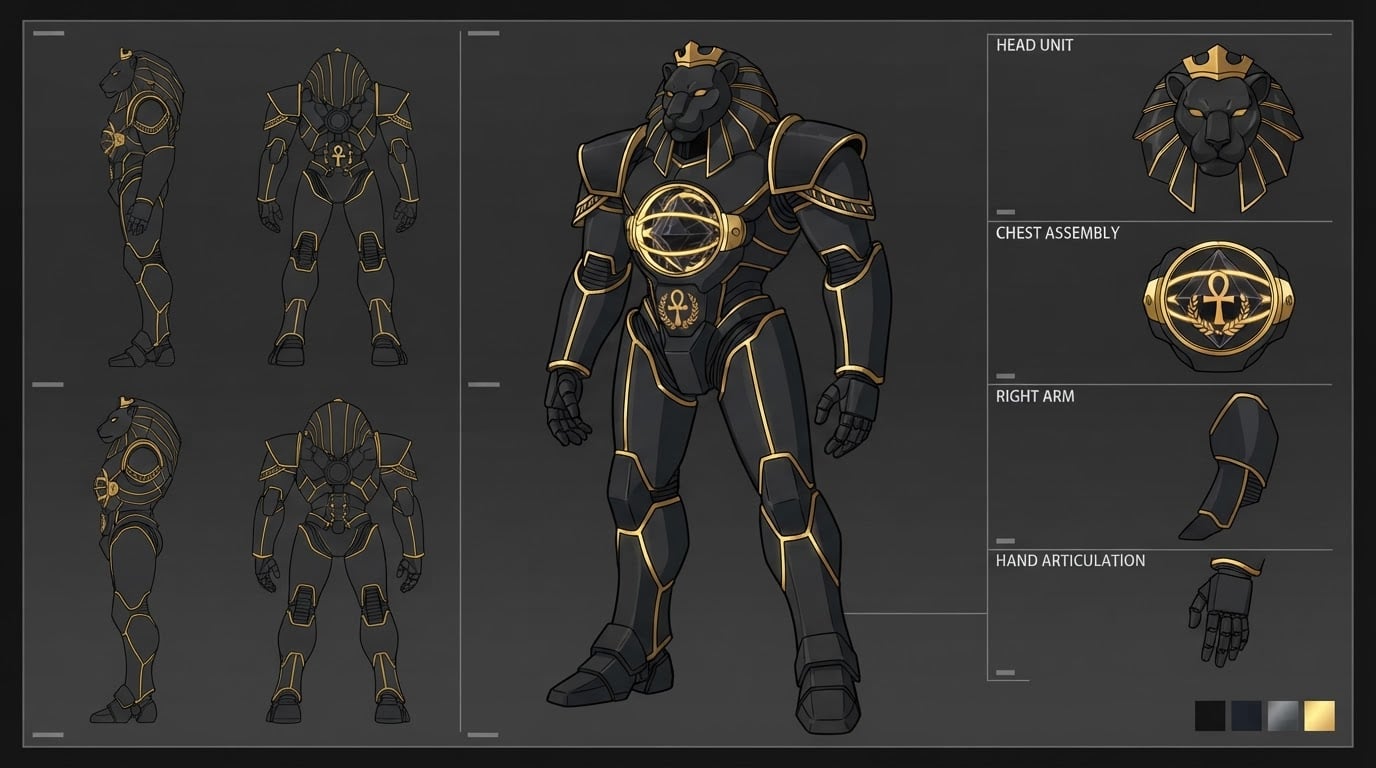
Plate 14 · Null-Point Frame 'Sekhmet' · three-quarter, side and rear views with reactor cage, lioness head, pauldron and hand articulation
A colossal biomechanical humanoid war machine, and the one class in this record that is explicitly an Evangelion-analogue which refuses the Evangelion's method.
It has no core and no sealed organic mass. Where the MP frames carry a dark red organic mass behind an armoured viewport, Sekhmet carries a large exposed Null-Point Reactor in a gold-rimmed housing at the centre of its chest: a dark faceted singularity contained by a cage of glowing gold containment rings, radiating visible distortion.
Its head is a crowned lioness skull rendered as clean hard armour — a mane of angular gold-edged plates, a stern feline muzzle, blank gold eyes. Its proportions are heroic and symmetrical rather than gaunt, and it stands upright with feet planted, head level, arms at its side: the posture of something that guards rather than hunts.
None were produced. The programme reached the design plate and stopped there, because the evaluation was honest and the answer was no: against a mass-production Evangelion, a null-point humanoid was slower to field, vastly more expensive per unit, and harder to maintain than the alternatives that were already working. The Eva-Counter Artillery Frame could do the same job from a fixed braced position with one gun and no reactor. The Eva-Hunter infantry could do it in numbers. A handful of enormous, singular, irreplaceable machines was the wrong shape of answer to a war of attrition, and the Aossians knew it before they built one.
So Sekhmet exists only as this plate — a design that was correct in principle, outclassed in practice, and shelved by people who could have built it and chose not to. It is the one thing in this record that shows the legion's builders declining to make something, and the reasoning behind the refusal is more revealing than the machine.
Type
Biomechanical mecha · non-core
Power
Exposed null-point reactor
Production
None. Design study only — never built
Posture
Guard, not hunter
15Technology · Propulsion
Changing Vector Engine
AirSpaceAossian Tech
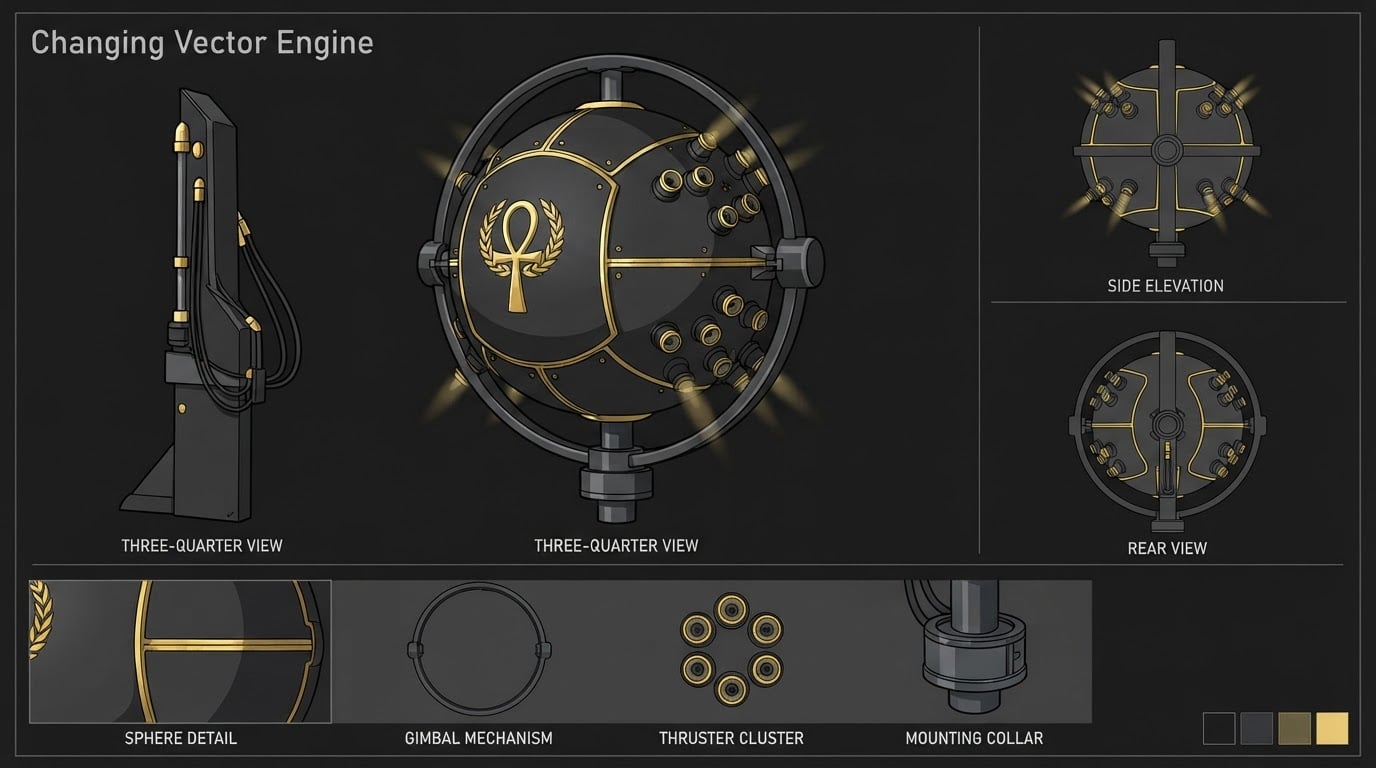
Plate 15 · Changing Vector Engine · the spherical gimball shown with meridian trim, gimbal ring, thruster-port clusters and mounting collar
The propulsion module that makes the legion's air and void craft possible, shown as a standalone component: a large spherical gimball engine for aeronautics.
A perfectly round armoured sphere with gold trim tracing its meridian lines, mounted inside a skeletal gimbal ring frame that lets it rotate freely on two axes. Instead of a single nozzle, the sphere's surface is studded with ranks of small thruster ports distributed evenly across the whole ball, each capable of firing at a different angle, with faint gold exhaust venting in several directions at once.
Because thrust can be aimed anywhere on a sphere that itself rotates freely, a craft using this engine changes vector without turning. It does not bank, does not pivot, does not point its nose where it intends to go — it simply begins moving in a new direction, instantaneously and equally on every axis. Human aerospace design spends its entire engineering budget on the assumption that an aircraft must face the way it travels. This engine makes that assumption false.
Type
Spherical gimball engine
Axes
Free rotation on two axes
Thrust
Distributed port ranks, all directions
Effect
Vector change without turning
16Technology · Displacement
Slip-Stream Drive
LandAossian Tech
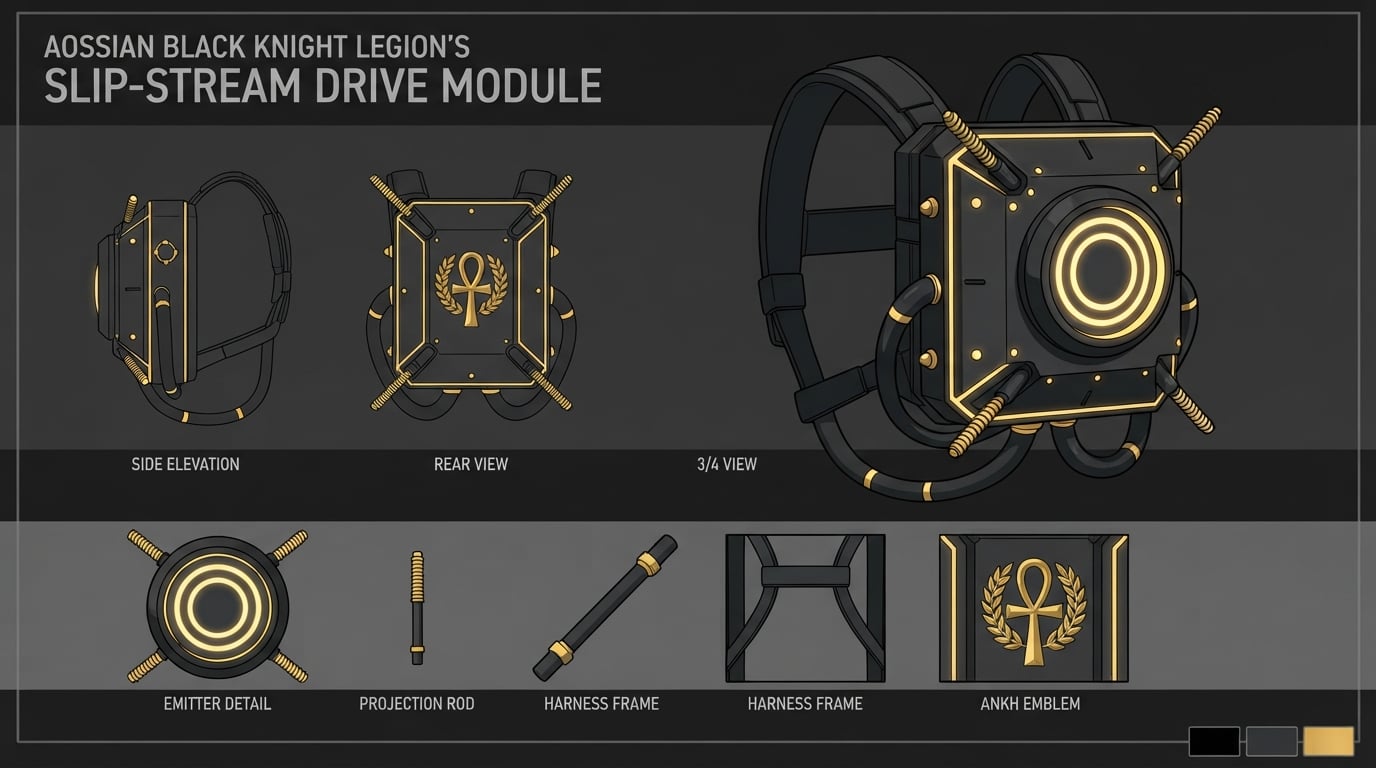
Plate 16 · Slip-Stream Drive · backpack module with circular emitter plate, projection rods, harness frame and casing ankh
A compact personal displacement module, carried on a soldier's back, and the single most disorienting piece of equipment the legion issues.
A flat rectangular backpack unit in matte black with gold edge trim and an ankh on the casing, carrying on its face a large circular emitter plate of concentric glowing gold rings — like a lens or a portal iris — with four gold-coiled projection rods standing out from the corners at angles. Heavy conduits run from the unit around the mount, and the assembly rides on an adjustable harness frame.
The Slip-Stream shifts the user's placement in time and space, locally, to a maximum of fifty metres. It is not teleportation — nothing is broken down or reassembled and the user does not travel. Space at the destination is briefly folded by warp so the user is placed there, and the fifty-metre limit is not a design choice but the boundary at which the fold can no longer be held stable.
Fifty metres is enough to cross a street, pass through a wall or arrive behind a position, and the range is short precisely because that is all a soldier needs: a tactical instrument, not a transport. Nobody who watched a Black Knight walk through a building has described it twice the same way.
Type
Personal warp displacement module
Range
50 metres maximum
Principle
Local space folded, user placed
Carriage
Backpack, harness-mounted
17Class · Auxiliary
Auxiliary Synthetic 'Pal-Cat'
LandMetaAossian Tech
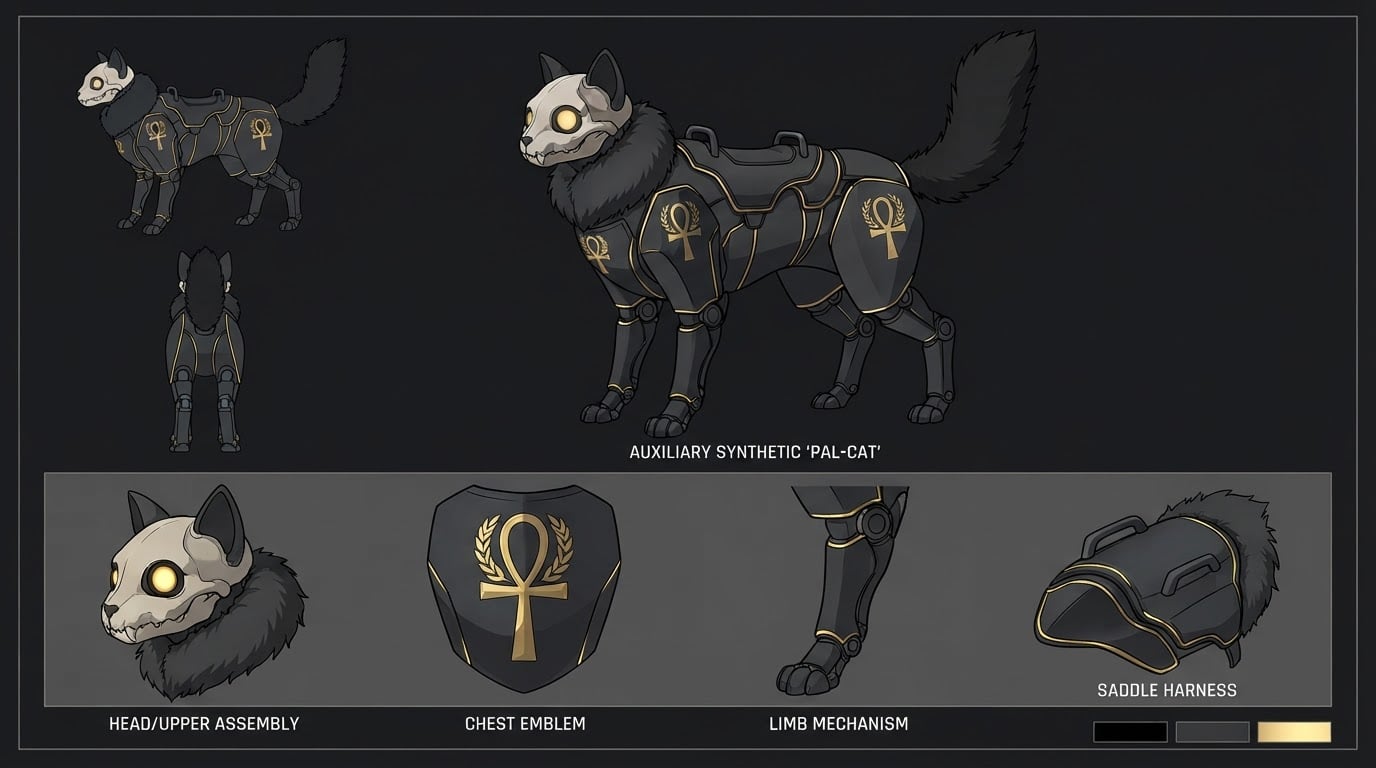
Plate 17 · Auxiliary Synthetic 'Pal-Cat' · three-quarter, side and rear views with head, chest emblem, limb mechanism and saddle harness callouts
A synthetic quadruped the size of a large Maine Coon, and the only class in this entire record designed for civilians rather than for war.
A sleek armoured quadruped in matte black plating with fine gold trim along every plate seam, an ankh wreathed in laurel etched small on each flank, and a ruffed collar of soft synthetic fur around the neck that makes it read as a cat at a glance. Feline skull, small pointed ears, pale bone-white faceplate, two large round glowing gold eyes, bushy plume tail. Along its back sits a low streamlined saddle harness with two small grab handles — clearly built to carry a child.
They were mass-produced, and they saved a great many lives. Unlike almost every other class in this record, the Pal-Cat was built in numbers, and the numbers were the point — one per district, one per shelter, one per cordoned block, seeded through the cities before the war and left in place during it. Their standing task is to find living civilians in buildings, rubble, collapsed streets and sealed zones, and they are small, light and quiet enough to reach people no vehicle and no soldier can.
They also carry a shield. Each Pal-Cat can project a small cascade field of its own — not large, no bigger than is needed to cover a human-sized object, and not for long. It is enough to put a bubble over a child in an open street, or over a doorway while someone is pulled through it. The specification is deliberately minimal: the field exists to cover exactly one person at a time, and the Pal-Cat is built to be the thing standing between that person and whatever is coming.
It is the only class in the legion that carries no weapon. Every other specification in this record is written around what a thing can destroy; this one is written entirely around getting someone to safety, and it is the one that worked.
Size
Maine Coon class
Armament
None
Task
Search · protection · evacuation
Field
Small cascade field · one person
Feature
Saddle harness with grab handles
The Essential Fact
The Black Knights have no crews. Not remote operators, not a command staff, not a skeleton maintenance element — no human beings inside them, at any level. The legion is a self-maintaining, self-repairing, self-directing body of 1,412,000 machines that arrived, took position, and required nothing from the human side except that humanity not stand in front of it.
Every comparison in this record follows from that fact, and so does every difficulty the human side had with them: they could not be integrated into an order of battle, because they did not take orders, did not report, did not need supply, and could not be recalled. Commanders assigned them an objective and then stayed well clear. The most common mention of the legion in human sources is not a battle report but a boundary marking an area that was not to be entered.
The Comparison, Stated Plainly
By every measurable characteristic — armour, mobility, energy transfer, autonomy, logistics, endurance — the Black Knights are two generations ahead, and the gap is not incremental: the human side could not damage them, could not jam them, could not outrun them, could not supply them, and could not build them.
Where human technology substitutes crews, supply chains and numbers, this legion substitutes material science and autonomy. Humanity did not fight alongside an ally in the Succession War. It was permitted to stand under the same sky as one.
The Uncomfortable Addendum
The legion was built to fight Evangelions. The Eva-Hunter class exists because somebody anticipated having to fight a machine humanity already possessed, and built anti-Evangelion infantry, over-scaled rifles and positron ammunition for that purpose.
The Black Knights did not arrive in the war as humanity's invention. They arrived as a solution to a problem humanity had not yet understood it was. And the force that saved the eastern cities was, from first to last, only ever following the last instruction anyone gave it.